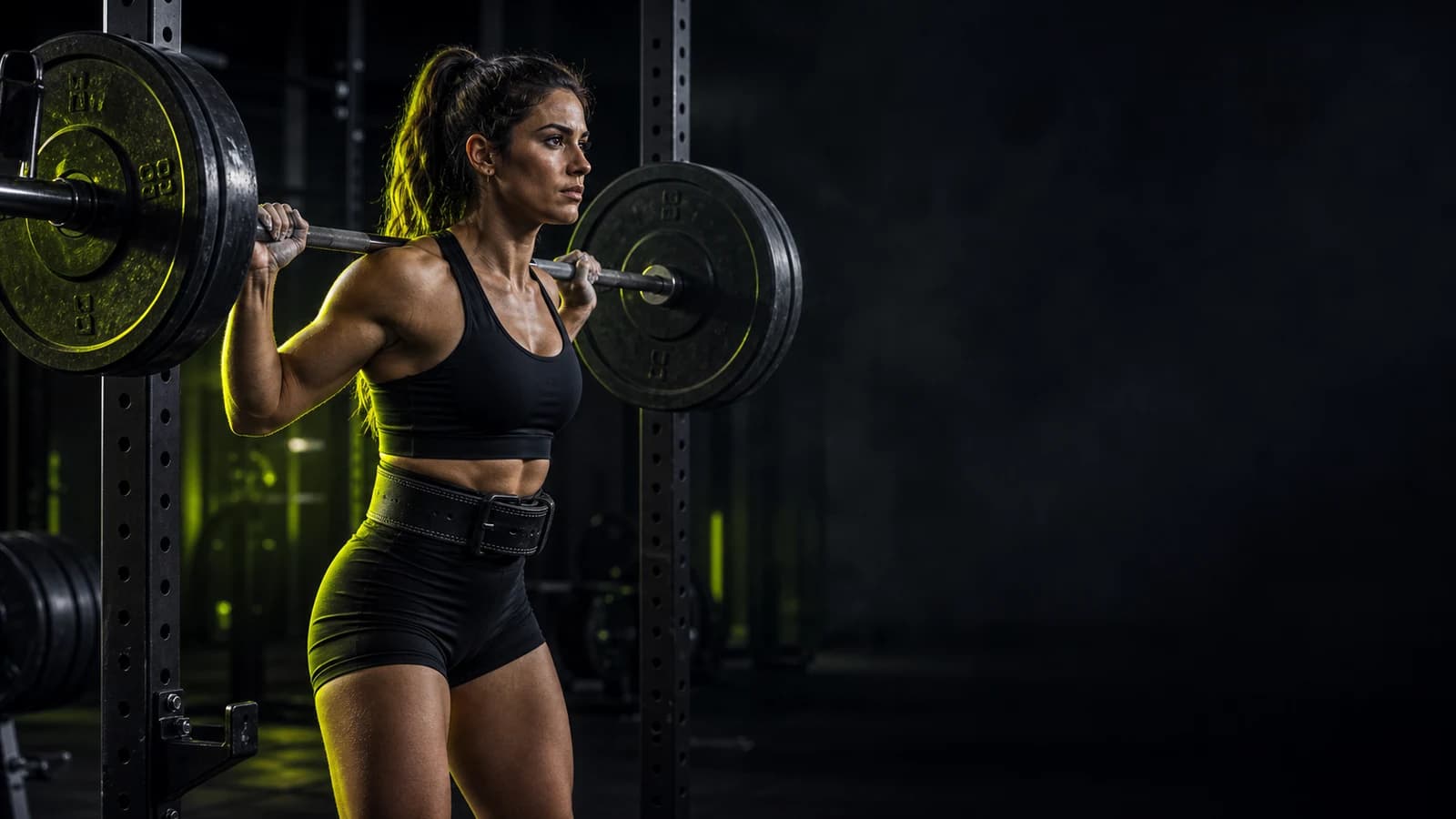
Strength training for women over 40 is one of the most evidence-backed things you can do for your body — and it needs to be deliberately different from training in your 20s. After 40, estrogen begins to decline, muscle mass drops roughly 1–2% per year without resistance training, and bone density starts to fall. Two to three well-programmed lifting sessions per week directly counteract all three.
Here is the complete guide: what to train, how to progress it, and how to make the consistency stick.
Why Strength Training Is Different for Women After 40
Before 40, you can outrun a lot of programming errors with volume and sheer effort. After 40 — especially in perimenopause and beyond — three things shift the equation:
Estrogen and muscle protein synthesis. Estrogen plays a direct role in how efficiently muscles respond to a training stimulus. As levels fluctuate and fall, you need heavier loads and more protein (aim for 1.6–2 g per kg of bodyweight daily) to drive the same adaptation.
Bone density. Women lose up to 20% of bone density in the five to seven years around menopause. Resistance training — particularly compound lifts with progressive load — is the single strongest non-pharmaceutical intervention to slow this loss. Cardio alone does not do the job.
Recovery time. Inflammation markers rise with age, and the central nervous system takes longer to recover between hard sessions. This is not a reason to train less; it is a reason to program smarter: fewer junk sets, heavier purposeful work, and built-in recovery days.
The good news: the response to resistance training remains remarkably strong at every age. Muscle is built through the same mechanism at 45 as at 25 — the inputs just need to be intentional.
How Often Should Women Over 40 Lift Weights?
Two to three sessions per week is the evidence-based sweet spot — enough stimulus to drive progressive overload across all major movement patterns, enough rest to fully recover.
Three sessions per week is ideal for most women. Two sessions per week still delivers meaningful strength and bone density benefits and is a realistic floor for a busy schedule. Four or more sessions can work, but demands careful programming. Full-body or upper/lower splits are more forgiving than body-part splits that leave you training on under-recovered muscles.
One consistency principle matters more than any other: sessions you actually do compound over time into sessions you skip. Show up two or three times a week for a year and you will be dramatically stronger than someone who trained five days a week for eight weeks and burned out.
Best Strength Training Exercises for Women Over 40
Focus on compound movements — multi-joint exercises that load the skeleton, drive a strong hormonal response, and build functional capacity that transfers to real life.
Lower body:
- Goblet squat or barbell back squat — the foundational knee-dominant pattern; loads the quads, glutes, and spine
- Romanian deadlift — the single best posterior chain builder; targets hamstrings and glutes through a full range of motion
- Hip thrust — maximizes glute activation with low spinal load; excellent complement to deadlifts
Upper body:
- Dumbbell or barbell row — builds the mid-back, counteracts desk posture, and protects shoulder health
- Overhead press — develops shoulders and upper back; also a bone-loading movement for the forearm and wrist
- Push-up or chest press — horizontal push that scales cleanly from bodyweight to heavy barbell
Accessory:
- Farmer's carries — loaded walking builds grip strength, core stability, and bone density simultaneously
- Single-leg work (step-ups, reverse lunges) — addresses left-right asymmetries and reduces knee and hip injury risk
Avoid building a program entirely around machines and light, high-rep isolation work. Light weight does not produce a meaningful bone density response and misses the progressive overload signal your body needs to adapt.
Progressive Overload After 40: The Only Metric That Matters
Progressive overload means your training must get harder over time — more weight, more reps, or cleaner form under the same load — or you stop adapting.
This is where logging becomes essential. If you do not know what you lifted last session, you cannot know whether you progressed this session. "I think I did more" is not a feedback loop.
The simplest rule: beat last session by at least one rep or 2.5 kg on at least one set. When you can hit the top of your rep range cleanly (e.g. 3×10 with good form), add load next session. This one principle, applied consistently, is the engine that makes everything else work.
GainLogger's progressive overload tracking surfaces your previous session's exact weights and reps directly in the logging screen — so you always know the exact target to beat. When you hit a new PR, it is logged and marked. That moment of visible progress is the feedback loop that keeps consistency alive over months and years.
Perimenopause and Strength Training: What to Know
Perimenopause — typically ages 40 to 51 — is characterized by fluctuating estrogen and progesterone. Resistance training during this phase:
- Reduces hot flashes and mood fluctuations — regular strength training consistently shows symptom reduction in research
- Preserves lean mass during hormonal flux — muscle protected here directly predicts metabolic health in your 50s and 60s
- Responds well to creatine — a 2025 PERIHIRT trial found creatine supplementation alongside resistance training produced superior muscle and bone outcomes for perimenopausal women vs training alone; 3–5 g/day is worth discussing with your doctor
One practical adaptation: track your energy and strength patterns across your cycle. Many women find the follicular phase (post-period, days 1–14) is the window for heavier, higher-intensity work, while the luteal phase (pre-period, days 15–28) suits slightly lower intensity with more recovery emphasis. A workout log lets you see these patterns over months — not just feel them session by session.
How to Track Your Strength Progress (and Actually Stay Consistent)
The biggest limiter for women who start strength training after 40 is not programming — it is consistency over months and years. The research is unambiguous: the women who build the most strength and protect bone density longest are the ones who show up most reliably, not the ones who trained hardest for six weeks.
Streaks, milestones, and visible PRs are the psychological infrastructure that makes the long game sustainable.
When you can see that you squatted 15% more weight than three months ago, or that today was your 50th logged session, something clicks. That visible progress makes the next session easier to start.
GainLogger's features track all of it — session history, personal records, milestones, and streaks — and core logging is free. Share a PR, hit a milestone, keep the streak alive. That is what strength training looks like over years: small progressions logged consistently, adding up to a body that is genuinely stronger.
Sample Weekly Strength Training Plan for Women Over 40
three-day full-body routine (adjust loads each session using last week's numbers):
Day 1 — Monday
- Goblet squat — 3×8–10
- Dumbbell row — 3×8–10 each side
- Romanian deadlift — 3×8–10
- Push-up or dumbbell chest press — 3×10–12
- Farmer's carry — 3×20 m
Day 2 — Wednesday
- Hip thrust — 3×10–12
- Overhead press — 3×8–10
- Reverse lunge — 3×8 each leg
- Plank — 3×30–45 sec
Day 3 — Friday
- Trap-bar or barbell deadlift — 3×5 (heavier, lower rep)
- Incline dumbbell press — 3×10
- Lat pulldown or assisted pull-up — 3×8–10
- Step-up — 3×10 each leg
Add 2.5 kg (5 lb) to barbell movements every one to two weeks. Log every session. Celebrate every PR.
Strength Training for Women Over 40: The Bottom Line
The research is clear and consistent. Resistance training is the most effective tool available to women over 40 for preserving muscle, protecting bone, managing hormonal symptoms, and building the kind of body that performs well for decades.
The program does not need to be complicated. Three days per week, a handful of compound movements, progressive overload tracked session by session. The only variable that truly separates the women who get dramatically stronger from the ones who plateau is the habit of logging — knowing your numbers, beating them, and building momentum over time.
Log it. Progress it. Watch your numbers climb.
Keep reading
Start tracking your workouts today
Available for free on iOS and Android.